The Day of the Last Supper, When Jesus Christ Instituted the Eucharist
The Holy Thursday liturgy invites us to enter deeply into the mystery of Christ's Passion. Those who wish to follow him are called to sit at his table and prayerfully remember everything that happened on the night he was betrayed. The Lord Jesus also gives us a powerful example of the vocation to serve the world and the Church when he chooses to wash his disciples' feet.
In this account, the Gospel of John presents Jesus knowing that the Father had placed everything in his hands, that he had come from God and was returning to God. Yet his love for every person leads him to kneel before his disciples, wash their feet, and offer a striking sign of tireless welcome and service.
Saint Paul completes the picture by reminding the faithful and Christian communities of what he himself received: on that holy night, Christ gave himself and established an enduring sacrament. Bread and wine become the food of his Body and Blood for all who remember him and await his coming at the end of time. In this way, the Eucharist was instituted.
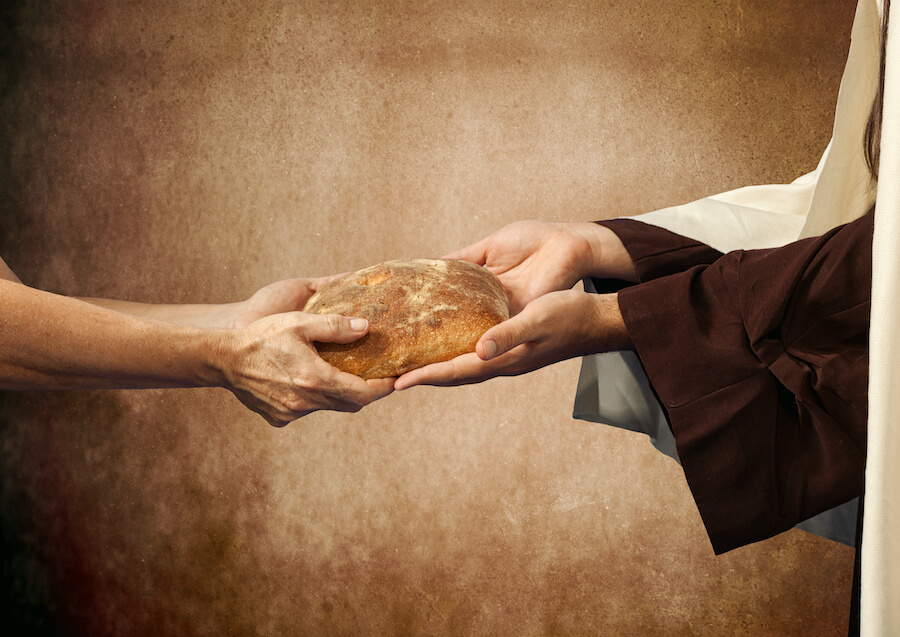
The Holy Mass is therefore the celebration of the Lord's Supper, in which Jesus Christ, on the eve of his Passion, “while he was at supper with his disciples, took bread...” (Mt 28:26).
He desired that, as at his Last Supper, his disciples should gather and remember him by blessing the bread and wine: “Do this in memory of me” (Lk 22:19).
Before he was handed over, Christ gave himself as food. At that Supper, Jesus anticipated his death through a prophetic sign and a real offering before his Passion. Therefore, “whenever we eat this bread and drink this cup, we proclaim the death of the Lord until he comes” (1 Cor 11:26).
For this reason, we can say that the Eucharist is a memorial not only of the Last Supper but of the Death of Christ, who is Lord and victor over death, the risen Lord whose return we await as he promised at his farewell: “A little while and you will no longer see me, and again a little while later and you will see me” (Jn 16:16).
As the preface for this day proclaims, Christ, the true and eternal priest, offered himself as the saving victim and commanded us to perpetuate this offering in his memory. This Eucharist is celebrated with its own particular character as the Mass of the Lord's Supper.
Unlike other Eucharistic celebrations, this Mass does not directly celebrate either Christ's death or his Resurrection. We do not move ahead of Good Friday or the Easter Vigil.
Today we rejoice in understanding that the Lord's death did not end in failure but in victory. It had a purpose: it was a surrender, a gift of self, offered for us and for our salvation, as the Creed says. “No one takes my life from me,” Jesus said, “but I lay it down of my own accord. I have power to lay it down” (Jn 10:16). Today he tells us that it was given for the forgiveness of sins (Mt 26:28).
This Eucharist should therefore be celebrated with fitting solemnity. Yet its songs, message, and signs are neither as exuberant as those of the Easter Vigil, when we celebrate the glorious outcome of Christ's self-giving, nor as solemnly sorrowful as those of Good Friday. What we emphasize today is that the Father gave us his Son so that we might have eternal life (Jn 3:16), and that the Son freely gave himself for us, even to death on a shameful cross.
There is joy today, and the Church briefly sets aside Lenten austerity to sing the Gloria. It is the joy of knowing that God loves us, but it is also sober and touched by sorrow because we know the price Christ paid for us.
We might say that the joy is ours and the suffering is his. Yet joy remains central, because love and self-giving cannot be reduced to sadness: whoever gives himself in love does so to bring joy.
In the liturgy today, we celebrate the Passover of the night of the Exodus (first reading, Ex 12), not yet the arrival in the Promised Land (Jos 5:10ff).
Today begins the Paschal struggle between death and life. Life is never swallowed up by death, though death fights against it. Holy Saturday night will sing of victory marked by blood; Holy Thursday is the hymn of the struggle already carrying the promise of victory, because its weapon is love.